
The "weaponisation" of economic activity - through tariffs and sanctions - is now a reality, with countries leveraging these tools strategically, External Affairs Minister S Jaishankar said at the Raisina Dialogue recently.

'If you look at the order books of capital equipment companies or money deployed on the ground, there is forward movement in terms of actual investment by the private sector.'

India and the US are expected to have smooth trade negotiations after US President Donald Trump and Indian Prime Minister Narendra Modi had a productive meeting during Modi's visit to the White House last month, Stephen A Schwarzman, chairman, chief executive officer, and co-founder of one of the world's largest alternative investment firms, Blackstone Group, said in Mumbai on Wednesday.

Challenging the decision of the Biden Administration to investigate the activities of Indian billionaire Gautam Adani and his companies, an influential Republican lawmaker on Tuesday said such selective actions risk damaging critical alliance partners.

India's economic growth is now 'extremely fragile' and needs all the support that it can get, as private consumption and capital investment are yet to pick up, RBI Monetary Policy Committee (MPC) member Jayanth R Varma said on Friday. Varma further said out of the four engines of growth for the economy, exports and government spending supported the Indian economy through the pandemic, but other engines need to pick up the baton now. " I like to think in terms of the four engines of growth for the economy: exports, government spending, capital investment and private consumption. "...while exports cannot be the main driver of growth because of the global slowdown, government spending is necessarily limited by fiscal constraints," he told PTI.

'Indian macro conditions have never been better, and many businesses will safely compound earnings over the next five years.'
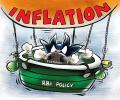
The Reserve Bank of India (RBI) has projected retail inflation at 4.2 percent for the next financial year beginning April while retaining the forecast for 2024-25 at 4.8 percent. The central bank attributed the expected easing of inflation to good kharif production, winter-easing in vegetable prices and favorable rabi crop prospects. However, the RBI also noted that continued uncertainty in global financial markets coupled with volatility in energy prices and adverse weather events presents upside risks to the inflation trajectory.

'Unfortunately, India and Pakistan could learn a 'lesson' from this conflict that will make them more likely to use these weapons against each other in the future.' 'Rounds of missile and drone attacks could be more routine features of their hostility, just like artillery fire has become a familiar fact of life along the Line of Control.'

Average global growth prospects for the next 12 months and the next three years are 35 per cent and 49 per cent, respectively.

Globally, gold fell 0.2 per cent to $1,162.25 an ounce in Singapore.

Government has been able to push through economic reforms, especially allowing foreign investment in multi-brand retail.

Fitch Ratings on Monday said India's steady GDP growth outlook, improved banking sector's financial health and expected interest-rate cuts in 2025 will support credit access for corporates in FY26.

India's economy continues to be robust, but downside risks such as rising crude oil prices, adverse weather conditions, and the global banking crisis outweigh the upside potential in gross domestic product (GDP) growth in the current financial year (FY24), the finance ministry said on Tuesday in its Monthly Economic Review for March. "We reiterate that downside risks to our official forecast of 6.5 per cent for real GDP growth in FY24 dominate upside risks," the review said. "Opec's surprise production cut has seen oil prices rise in April, off their lows of low-seventies per barrel in March.

Reminiscent of the past two years, the market has made positive strides ahead of the Union Budget 2023-24 (FY24). The benchmark National Stock Exchange Nifty has gained 1.8 per cent in the last month. Typically, markets tend to gain ahead of the Budget as investors build in optimism.

In a dazzling resurgence, foreign investors have graced the Indian equity markets with an influx of nearly Rs 1.5 lakh crore in 2023, fuelled by optimism over the country's resilient economic fundamentals amid shadows of a gloomy global scenario. Experts believe that the positive trend may continue in 2024. This follows Indian equities witnessing the worst-ever net outflow of Rs 1.21 lakh crore by FPIs in 2022 on aggressive rate hikes by the central banks globally after net inflows for three consecutive years.

The Galwan clash occurred six months after the Doklam disengagement and two high-profile meetings. India should not be caught by surprise once again, asserts former foreign secretary Shyam Saran.

'Limited spillovers' to Asia's third-largest economy, even as world 'perilously close' to recession.

Former RBI governor Raghuram Rajan on Tuesday said it is too premature to think that India will replace China when it comes to influencing global economic growth. However, the situation may change going forward as India is already the world's fifth largest economy, it is growing and has the potential to keep expanding. At a World Economic Forum (WEF) press briefing on the recently released Chief Economists Outlook that saw majority of them expecting a global recession in 2023, Rajan said any recovery in the Chinese economy would definitely boost the global growth prospects.

India's economic growth prospects should remain strong over the medium term, with GDP expanding 6-7.1 per cent annually in fiscal years 2024-2026, S&P Global Ratings said on Thursday. In a report titled 'Global Banks Country-By-Country Outlook 2024', S&P said the banking sector's weak loans will decline to 3-3.5 per cent of gross advances by March 31, 2025, on the back of structural improvement, including healthy corporate balance sheets, tighter underwriting standards and improved risk-management practices. Interest rates in India are unlikely to rise materially, and this should limit the risk for the banking industry, it added.

After heavy selling in the past two months, foreign investors have staged a strong comeback to Indian equities with a net investment of Rs 24,454 crore in the first week of December amid stabilising global conditions and expectations of potential US Federal Reserve rate cuts. This revival follows significant outflows in the preceding months, with foreign portfolio investors (FPIs) pulling out a net Rs 21,612 crore in November and a massive Rs 94,017 crore in October - the worst monthly outflow on record.

Movement in the stock market this week will largely be driven by global trends, macroeconomic data announcements and trading activity of foreign investors, analysts said. Equity benchmark indices, which are on a dream run for the past several days, will also track trading in global oil benchmark Brent crude and movement of rupee against the US dollar. "The next FOMC (Federal Open Market Committee) meeting is scheduled for mid-September, but before that, the market will be closely watching upcoming US economic data.

The Finance Ministry expects the economic growth in the current fiscal to improve to 5.5 per cent from 5 per cent last year on back of likely pick up in agricultural output on account of good monsoon rains.

India should convert the Trump threat to an India opportunity, re-embracing a more liberal trade regime as a way of reviving manufacturing output and exports.

S&P Global Ratings on Wednesday upgraded India's sovereign rating outlook to positive from stable while retaining the rating at 'BBB-' on robust growth and improved quality of government expenditure. S&P said it could upgrade India's sovereign rating in the next 2 years if the country adopts a cautious fiscal and monetary policy that diminishes the government's elevated debt and interest burden while bolstering economic resilience.

Global brokerage firm CLSA has reversed its early tactical shift from Indian equities to Chinese stocks, and has decided to raise India allocation while cutting exposure to China. In its report titled 'Pouncing Tiger, Prevaricating Dragon', CLSA cited challenges facing Chinese markets in the aftermath of Donald Trump's victory in the US elections as the reason for the move. "Misfortune can happen in threes. So it has played out for Chinese equities over the past week.

Following another disappointing year in 2014, developing countries should see an uptick in growth this year, boosted in part by soft oil prices, a stronger US economy, continued low global interest rates, and receding domestic headwinds in several large emerging markets, it added.

'Pakistan is no longer a front-burner issue for America.'

Institutional investments in Indian real estate have seen a strong start to 2025, with inflows reaching $ 1.3 billion in the first quarter - a 31 per cent year-on-year (YoY) increase. This growth was primarily driven by domestic investments, which accounted for 60 per cent of the total inflows during the quarter. With $ 0.8 billion inflows, domestic investments saw a 75 per cent annual rise and were largely focused on industrial & warehousing and office segments.

Nitin Desai, who has known Dr Singh from 1971, extends his 'deepest condolences to his wife Gurcharan Kaur and to his three talented daughters Upinder, the historian; Daman, the writer; and Amrit, the human rights activist.'

Trump's sweeping tariffs and penalties on China-built ships have turned global shipping into the front line of economic war, observes Shyam G Menon.

India is expected to contribute 15 per cent to the global growth in 2023, an International Monetary Fund (IMF) official said on Tuesday. "Both India and China are expected to contribute 50 per cent of the global growth in the upcoming year (2023). "However, the share of India's contribution to global growth is expected to be around 15 per cent," Krishna Srinivasan, director, Asia and Pacific Department (APD) at IMF said at a roundtable with reporters from south Asian countries.

As per OECD's September estimates, global growth was to be 3 per cent this year and 3.6 per cent in 2016.

S&P Global Ratings on Friday said it will watch the fiscal numbers for the next 1-2 years, besides pro-growth policies of the new government, before deciding on India's sovereign rating upgrade. S&P, which earlier this week upgraded India's outlook to positive while retaining the sovereign rating at BBB-, expects the new government to continue with pro-growth policies, infrastructure investment and commitment to fiscal consolidation.

The World Bank on Tuesday raised the growth forecast for the Indian economy to 7 per cent for the current fiscal year on the back of recovery in agri sector and rural demand. World Bank had in June projected India to grow at 6.6 per cent for FY24. According to the World Bank Report released on Tuesday, India's growth continues to be strong despite a challenging global environment.

'Gold prices thrive on volatility and more so when the stock markets trend downward.'

India retains the tag of the fastest growing country among the world's major emerging economies

However, the Indian economy is expected to bounce back in 2021, the World Bank said.
Fitch Ratings on Tuesday retained India's economic growth forecast at 7 per cent for the current fiscal, but cut projections for the next two financial years saying the country is not impervious to global developments. In its December edition of the Global Economic Outlook, Fitch projected India's GDP to grow at 7 per cent in the current fiscal, at a slower rate of 6.2 per cent in 2023-24 and at 6.9 per cent in 2024-25. In September, Fitch projected 7 per cent growth for the current fiscal, followed by 6.7 per cent in 2023-24 and 7.1 per cent growth in 2024-25.

The first five months of 2023 have witnessed at least six major events/trends that augur badly for global economic and socio-political prospects, points out Shankar Acharya, former chief economic adviser to the Government of India.

Armed with necessary macro and micro growth drivers, India is on its way to becoming the fastest growing major economy in the world, a finance ministry report said. Rapid vaccination and teeming festivities will push India's ongoing recovery resulting in narrowing of demand-supply mismatches and greater employment opportunities, as per the monthly Economic Review prepared by the ministry.
